7.3: Atomic Emission Spectra and the Bohr Model . Web The following are his key contributions to our understanding of atomic structure: Electrons can exists at only certain distances from the nucleus, called orbits. Orbits closer to the nucleus are lower in energy. Electrons can move from.
7.3: Atomic Emission Spectra and the Bohr Model from qph.fs.quoracdn.net
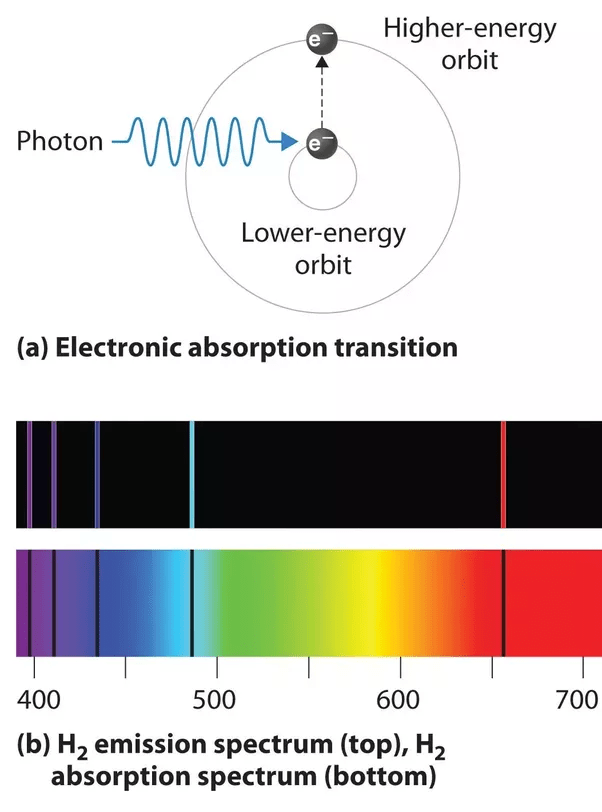
WebWhen an atom emits light, it decays to a lower energy state; when an atom absorbs light, it is excited to a higher energy state. If white light is passed through a sample of hydrogen,.
Source: image1.slideserve.com
WebLearning Objectives for Light, Matter, and Atomic Structure. Describe the basic properties of light as a wave. Identify the evidence for the particle nature of light as revealed by the.
Source: i.stack.imgur.com
WebAtomic Emission Line Spectra In a gas discharge tube energy is added to a gas which is adsorbed by electrons. These excited electrons enter high energy orbitals and then fall.
Source: ka-perseus-images.s3.amazonaws.com
Web Atomic Emission Spectra Electrons in atoms normally occupy the lowest energy states possible. Such an atom is said to be in the ground state. However,.
Source: qph.fs.quoracdn.net
WebThe wavelengths and frequencies of the light emitted by an atom (its emission spectrum) is determined by its electronic structure. In the Bohr model shown above you can see that.
Source: image3.slideserve.com
WebLight, Energy, and Electron Structure Introduction When a pure atomic gas such as hydrogen or helium is subjected to a high-voltage electrical discharge, light is produced.
Source: chem.libretexts.org
WebAtomic Spectra Light, Energy, and Electron Structure Introduction: Sunlight passing through a prism produces a rainbow of colors – the visible spectrum. The separation of.
Source: chem.libretexts.org
WebCHEM1315 Lab 8: Atomic Spectrum ChemCollective. The emission of photons (particles of light) from atoms is thought to occur in the following way: First, the atom absorbs.
Source: image3.slideserve.com
WebProcesses that occur within nuclei (e.g., electromagnetic transitions between energy states of the nucleus, beta decay, alpha decay, and electron capture) typically involve energies.
Source: image1.slideserve.com
WebTo know the relationship between atomic spectra and the electronic structure of atoms. The photoelectric effect provided indisputable evidence for the existence of the photon.
Source: image.slideserve.com
WebAtoms and Light: Exploring Atomic and Electronic Structure. In the early 20th century, identification of the internal parts of the atom (electrons,.
Source: image1.slideserve.com
WebThe Electromagnetic Spectrum is the range of all possible frequencies of light. First we must understand light which travels in waves. Wavelength ( ) is the distance between.
Source: www.chemistryland.com
WebAtomic Spectra: Energy, Light, and the Electron Introduction: An atom consists of a nucleus, containing protons and neutrons, and tiny electrons, which move around the.
Source: www.mpoweruk.com
WebAtomic Emission Spectra Light, Energy, and Electron Structure SCIENTIFIC. Introduction Spectrum tubes, fluorescent light bulbs, novelty “plasma globes,” and glowing “neon”.
Source: image.slidesharecdn.com
WebThe differences in energy between these levels corresponds to light in the visible portion of the electromagnetic spectrum. So the difference in energy (Δ E) between any two orbits or energy levels is given by Δ E = E n 1 − E.
Source: ircamera.as.arizona.edu
WebWith the Atomic Spectra: Light, Energy and Electron Structure—ChemTopic™ Lab Activity, learn to recognize continuous versus line emission spectra for light sources using.
0 komentar